Most people have no idea who Tlaloc is. A number of people who do don't think much of him. This is a crying shame, because Tlaloc is not only one of the most important gods in Aztec religion, he may be one of the most important gods in Central America.
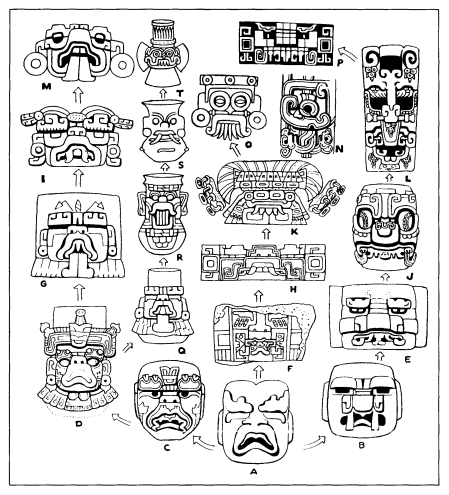
Here's a link to a diagram (which I tried and failed to post on this blog) from Miguel Covarrubias, a Mexican artist and archaeologist who made much groundbreaking work involving the Olmec "mother culture" of Mesoamerica. The originator in this diagram (A) is a stylized Olmec were-jaguar. Each route from that are the subtly evolving Mesoamerican rain gods. M is Cocijo, the Zapotec rain god. T is the Gulf Coast rain god. O is Tlaloc as the Mexica knew him. P is Chaac, the Maya rain god. No self-respecting Mesoamerican archaeologist would say they're all the same deity (Tlaloc appears in Mayan glyphs where Chaac also appears, representing concurrent Teotihuacan (Central Mexican) rulership, and Cocijo ceramics were found in Zapotec neighborhoods of Teotihuacan). However... their forms and worship are so similar that, in terms of Scion, it would be ludicrous to call them anything but one god taking many names and faces.
Essentially, this means that Tlaloc is the oldest and most widespread of the Mesoamerican gods. Only Quetzalcoatl comes close, also having ties to Olmec iconography. As such, it's sad that studying Tlaloc for something like this leaves a lot of holes for us to either fill, or simply sidestep.
Showing posts with label Aztec Alley. Show all posts
Showing posts with label Aztec Alley. Show all posts
Thursday, January 10, 2013

Sunday, December 30, 2012
Griff's Aztec Alley: Huitzilopochtli
Next on our journey, we come to one of the weirdest paradoxes among the Aztec gods: Huitzilopochtli.
Huitzilopochtli, the Hummingbird of the Left (alternately, Hummingbird of the South) is the only god that is truly "Aztec" or "Mexican" by virtue of being the patron deity of the Mexica tribe that emigrated from the north into Central Mexico and tried to make a name for themselves. At first, he was a very small deity, quite unimportant, but after Tenochtitlan became the seat of power in Mesoamerica, the religion was reformed to give him much greater respect and power.
Big H's role among the gods is a bit skewed. It's kind of obvious that his worship had taken over the previous cult of Nanahuatzin/Tonatiuh, who remains in the pantheon with a diminished role. Not to mention that the Spanish interpreters relied largely on the Mexica for unraveling the religion, which means that the Mexica's patron was given a much larger focus than he might have if another tribe was dominant. Huitzilopochtli was a ginormous deal in Tenochtitlan, with the colossal Templo Mayor in the city square having two temples atop it. One was for Huitzilopochtli. The other was for the rain and fertility god Tlaloc.
Huitzilopochtli is also the god who gets a lot of press because of his penchant for human sacrifice. While the numbers are skewed (Partly because the Spaniards inflated numbers to justify the invasion. Partly because the AZTECS inflated numbers because they were proud of the care they showed their deities), Huitzilopochtli's feast days were a neverending parade of prisoners of war being dragged up a pyramid, whereupon their hearts were removed, placed in a stone bowl, and burned. While other gods had odd and creative means of sacrificing their victims, none of them could beat Huitzilopochtli for sheer volume.
Which, when you factor in that they thought that NOT sacrificing an army's worth of soldiers would bring about the end of the world as we know it, is understandable.
Huitzilopochtli, the Hummingbird of the Left (alternately, Hummingbird of the South) is the only god that is truly "Aztec" or "Mexican" by virtue of being the patron deity of the Mexica tribe that emigrated from the north into Central Mexico and tried to make a name for themselves. At first, he was a very small deity, quite unimportant, but after Tenochtitlan became the seat of power in Mesoamerica, the religion was reformed to give him much greater respect and power.
Big H's role among the gods is a bit skewed. It's kind of obvious that his worship had taken over the previous cult of Nanahuatzin/Tonatiuh, who remains in the pantheon with a diminished role. Not to mention that the Spanish interpreters relied largely on the Mexica for unraveling the religion, which means that the Mexica's patron was given a much larger focus than he might have if another tribe was dominant. Huitzilopochtli was a ginormous deal in Tenochtitlan, with the colossal Templo Mayor in the city square having two temples atop it. One was for Huitzilopochtli. The other was for the rain and fertility god Tlaloc.
Huitzilopochtli is also the god who gets a lot of press because of his penchant for human sacrifice. While the numbers are skewed (Partly because the Spaniards inflated numbers to justify the invasion. Partly because the AZTECS inflated numbers because they were proud of the care they showed their deities), Huitzilopochtli's feast days were a neverending parade of prisoners of war being dragged up a pyramid, whereupon their hearts were removed, placed in a stone bowl, and burned. While other gods had odd and creative means of sacrificing their victims, none of them could beat Huitzilopochtli for sheer volume.
Which, when you factor in that they thought that NOT sacrificing an army's worth of soldiers would bring about the end of the world as we know it, is understandable.
Monday, November 19, 2012
Griff's Aztec Alley: Quetzalcoatl
Once again, we're delving into the Aztec Pantheon and revamping the, to be honest, random and occasionally batshit insane associations given to the gods. Last time, we looked at the mess that was Texcatlipoca, and now we turn to his twin and rival, Quetzalcoatl.
Just like his brother, Quetzalcoatl is given a metric assload of associated powers. In the original book, he's given Epic Charisma, Epic Intelligence, Animal (Resplendent Quetzal), Fertility, Guardian, Earth, Health, Itztli, Justice, Psychopomp, Sky, and Water. 12 powers. A number of which feel entirely random.
Much like Tezcatlipoca, though, I can understand why White Wolf went overboard. Quetzalcoatl is an important deity, and one that has intrigued Western civilization upon discovering the Aztecs. Furthermore, he is an old deity, with ties to the Olmec "mother" civilization of Mesoamerica and who seemingly has a hand in every culture in that region. Feathered serpent motifs are present in most cultures' religious iconography. Only Tlaloc is more ubiquitous.
Quetzalcoatl is also the only god who completely, unequivocally is also a Mayan deity as well as an Aztec deity. While Tlaloc, Chac, and Cocijo make sense as one god for the purposes of Scion, if you were to tell most Mesoamerican scholars they were all the same god, they would smack you with the flat of a maquahuitl. However, most agree that the Quetzalcoatl is Kukulcan is Gukumatz.
Just like his brother, Quetzalcoatl is given a metric assload of associated powers. In the original book, he's given Epic Charisma, Epic Intelligence, Animal (Resplendent Quetzal), Fertility, Guardian, Earth, Health, Itztli, Justice, Psychopomp, Sky, and Water. 12 powers. A number of which feel entirely random.
Much like Tezcatlipoca, though, I can understand why White Wolf went overboard. Quetzalcoatl is an important deity, and one that has intrigued Western civilization upon discovering the Aztecs. Furthermore, he is an old deity, with ties to the Olmec "mother" civilization of Mesoamerica and who seemingly has a hand in every culture in that region. Feathered serpent motifs are present in most cultures' religious iconography. Only Tlaloc is more ubiquitous.
Quetzalcoatl is also the only god who completely, unequivocally is also a Mayan deity as well as an Aztec deity. While Tlaloc, Chac, and Cocijo make sense as one god for the purposes of Scion, if you were to tell most Mesoamerican scholars they were all the same god, they would smack you with the flat of a maquahuitl. However, most agree that the Quetzalcoatl is Kukulcan is Gukumatz.
Saturday, September 22, 2012
Griff's Aztec Alley: Tezcatlipoca
Ah, Tezcatlipoca. The god we love to hate. Or hate to love. Tezcatlipoca, in the raw, is kind of a mess of associated powers, possessing Epic Appearance, Epic Charisma, Epic Dexterity, Epic Manipulation, Epic Wits, Animal (Jaguar), Darkness, Itztli, Magic, Moon, Mystery, Prophecy, Sun, War, and Kitchen Sink.
While ridiculous, the vast amount of powers granted to Tezcatlipoca is not entirely inaccurate. More so than any other Aztec deity, Tezcatlipoca was seen as omnipotent, omniscient, and omnipresent. He was considered one of the Four Tezcatlipocas, the black one in particular, associated with the northern cardinal direction, alongside Quetzalcoatl (the White Tezcatlipoca, associated with the east), Xipe Totec (the Red Tezcatlipoca, associated with the west), and Huitzilopochtli (the Blue Tezcatlipoca, associated with the south).
In Scion terms, the best explanation for this is that “Tezcatlipoca” is just a title and the Black Tezcatlipoca’s real name is a secret. However, in historical terms, this was probably the Nahua way of saying that all those other awesome gods are also Tezcatlipoca, that’s how awesome he is.
So, rather than try and pare down the powers from what we have given, I’m going to look at Tezcatlipoca from the myths associated with him and work from there...
Subscribe to:
Posts (Atom)